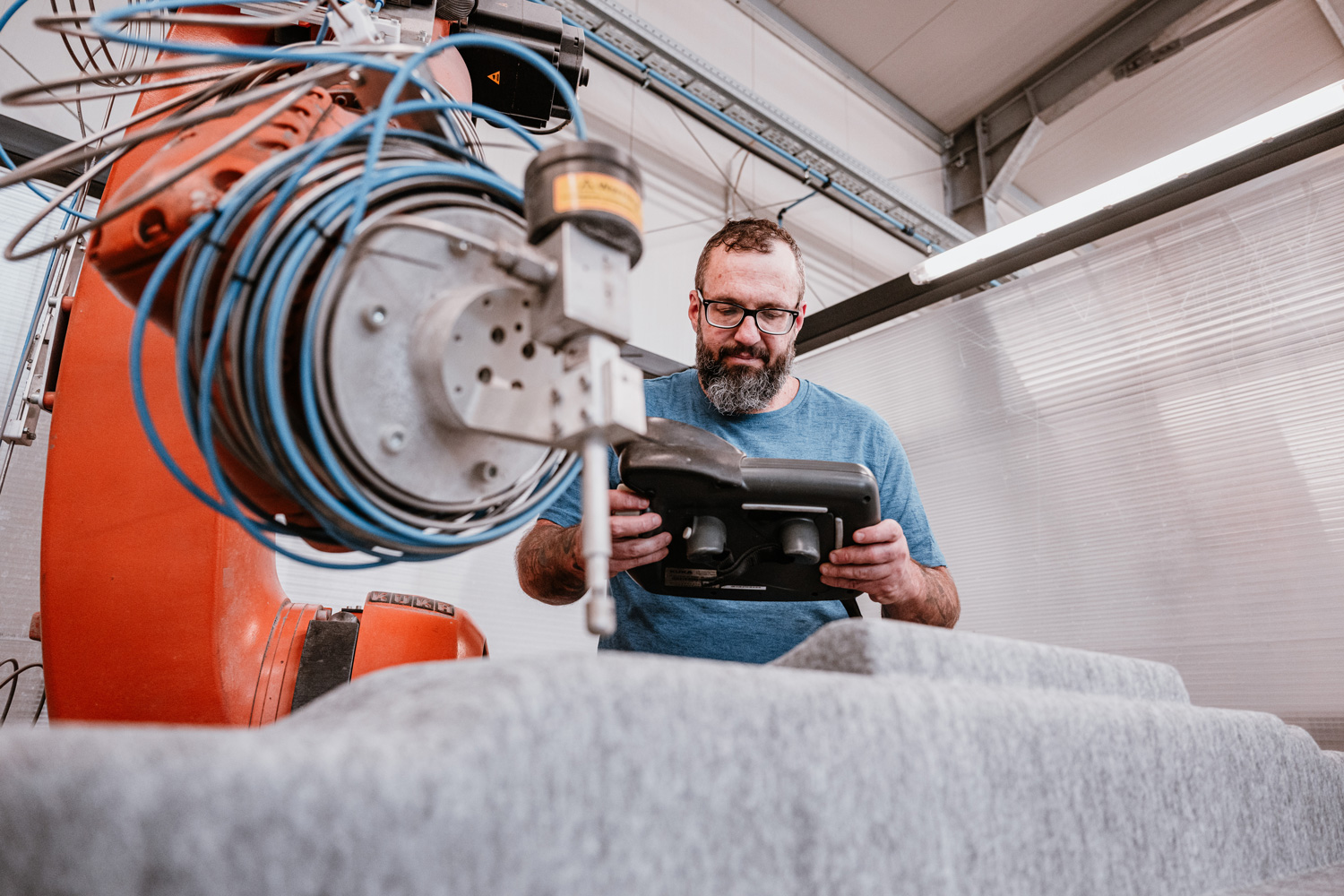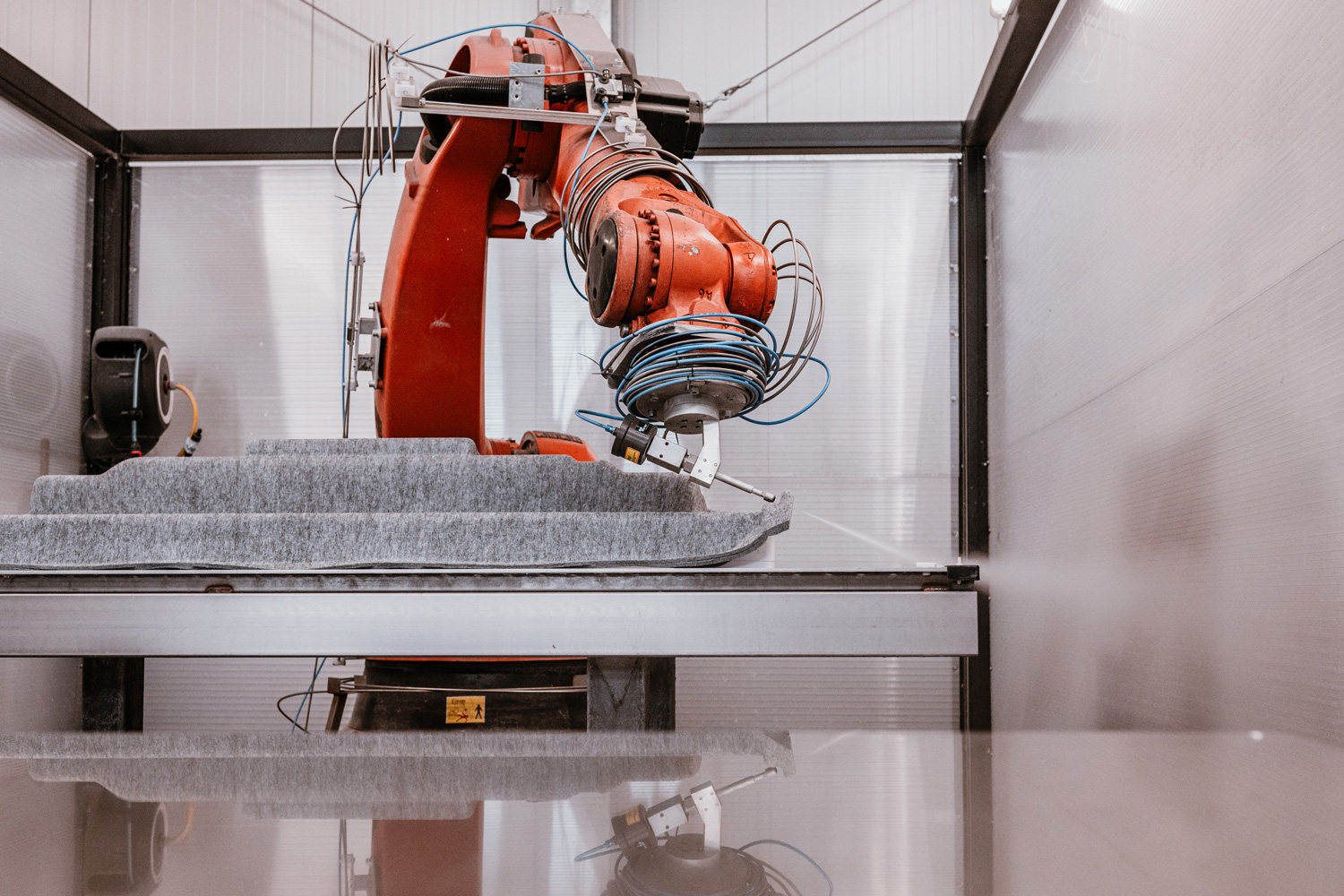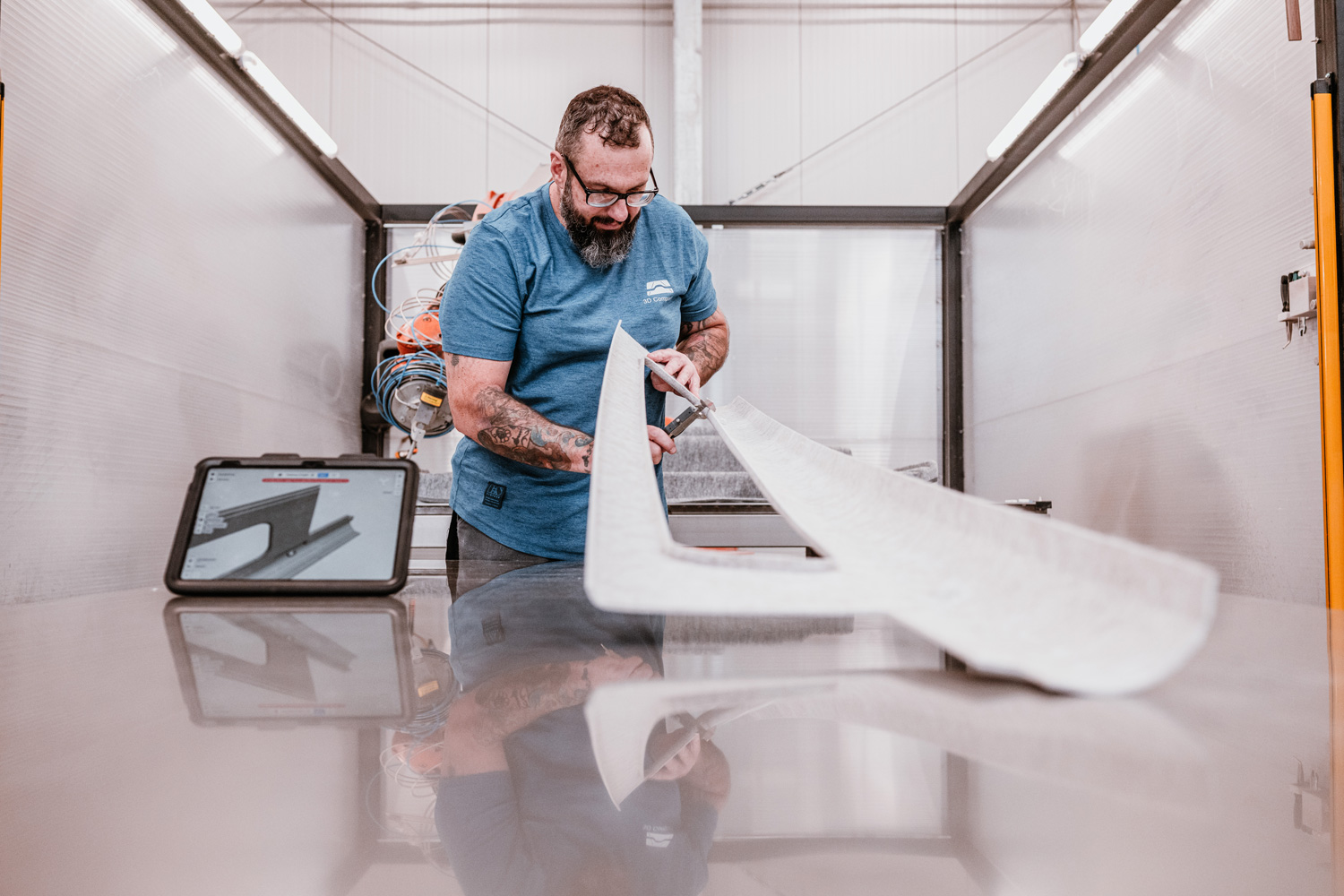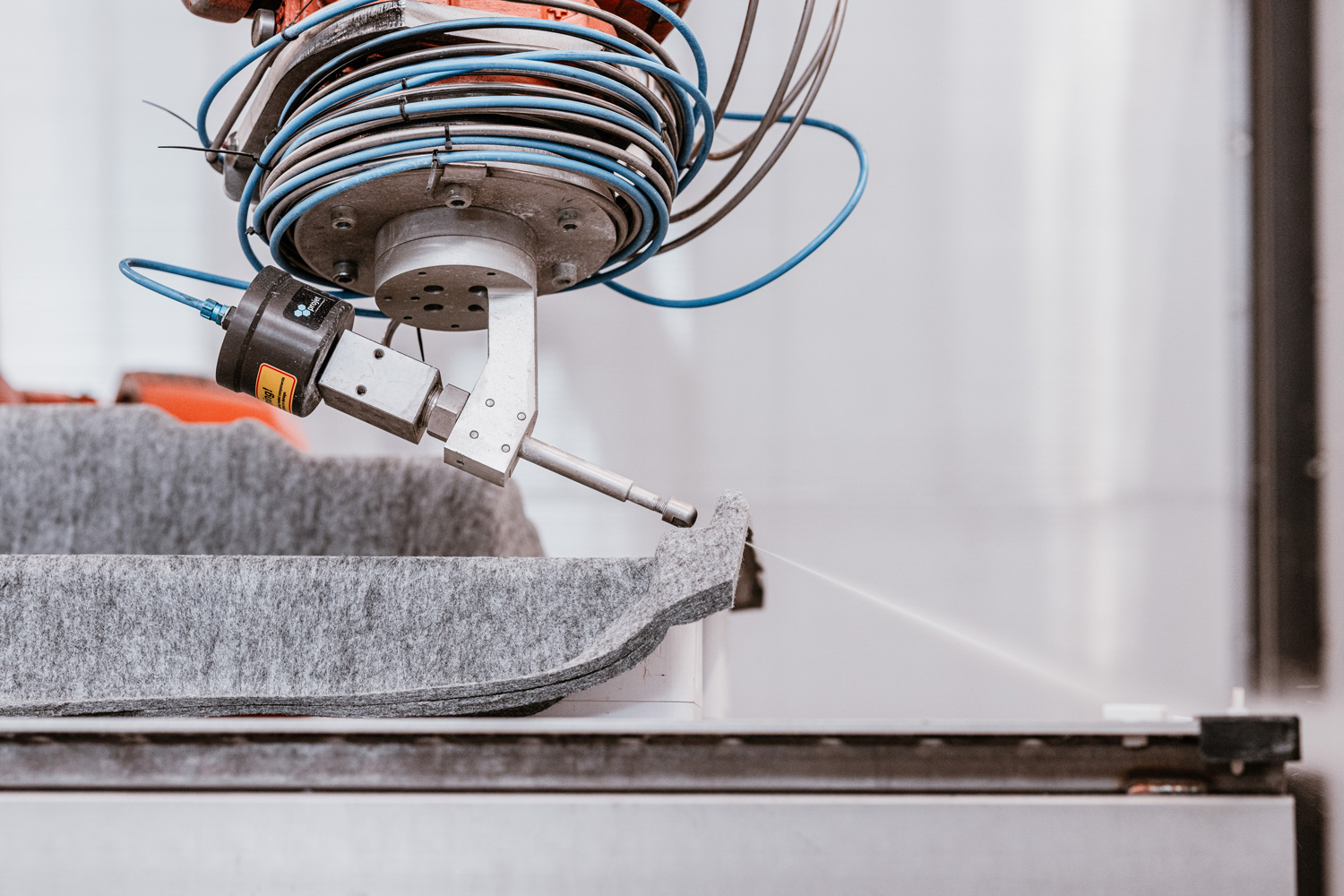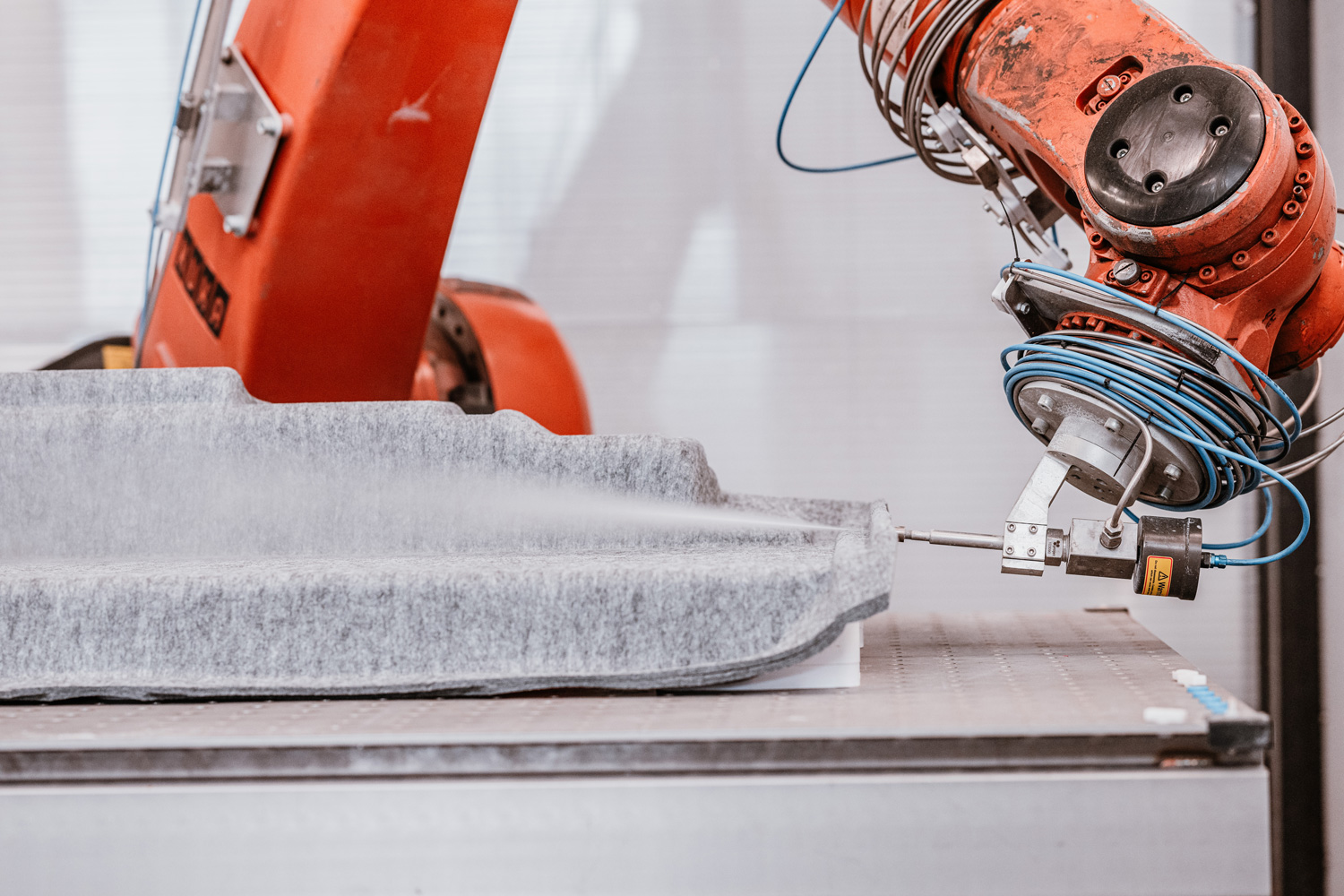
One way to give our composite moulded parts their final shape is to trim their edges with a high-pressure water jet. This process produces extremely clean and precise cut edges that require no post-processing and do not subject the material to thermal stress. Thanks to the very narrow cutting jet, even tight radii and the smallest angles can be achieved effortlessly, which is particularly important for complex cladding geometries. The combination of high speed, minimal tool wear and consistently excellent cutting quality makes water jet cutting a universal and efficient process for almost all components we manufacture.
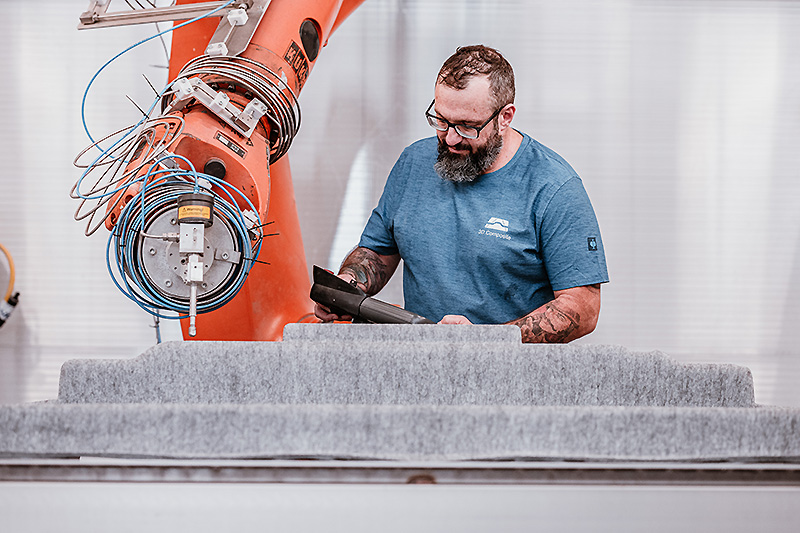
Water jet cutting allows extremely fine cuts to be made that are virtually invisible and do not detract from the appearance of the component. This enables us to create service flaps, openings or very delicate contours, for example, without leaving any visible cut edges. The technology also enables controlled perforations that remain invisible during normal use but can be opened in a targeted manner when necessary. We use this type of defined predetermined breaking point for airbag applications, among other things.
Water jet cutting produces extremely clean and precise edges, enables virtually invisible fine cuts and, thanks to its narrow jet, can even achieve very small radii and angles. The process is economical, gentle on materials and ideal for openings, service flaps and inconspicuous perforations that can serve as defined predetermined breaking points.
The size of the moulded part you require is limited by the size of the mould on the one hand and the operating radius of the cutting robot on the other. Our cutting robots are large enough to cut even large headliners for motorhomes and lorries with ease and precision.
The water jet reaches even the tightest radii, sharp angles and deep contours without restrictions. This allows even very demanding component geometries to be machined cleanly, completely and without changing tools.
The process combines high cutting speeds with consistently precise results. Repeatable processes, short set-up times and minimal wear make waterjet cutting particularly economical and reliable.
Since cutting takes place without heat generation, the material remains completely stable and unchanged. Fibres do not fuse, structures do not deform, and even sensitive non-woven surfaces are processed with the utmost care.
The technology we use for composite moulded parts depends primarily on your requirements. Which material is desired, how will the moulded part be used later, and what visual and haptic requirements must it meet? Here are some typical criteria that favour water jet cutting:
You would like to use a renewable raw material such as hemp, sisal, jute, kenaf, wool or cotton with a suitably high material thickness as your starting material.
The trim edges are a visible part of the design, which means that your composite moulded parts have a material thickness that makes the edges noticeable and visible. This is particularly important in the living areas of motorhomes, caravans and yachts.
The composite moulded parts you require have a complex geometry, which means that laser cutting is not a viable option as it would damage the moulded part.
Composite moulded parts are constantly handled, such as the handles on storage boxes. These should feel soft and not have any sharp edges. Water jet cutting ensures consistent material thickness and a pleasant feel.

We work closely with our customers to ensure that our moulded parts fit perfectly. We use our software to translate their product data into a 3D model of the moulds that we ultimately use to manufacture the product. In doing so, we naturally have to take into account the desired material and its specific properties, such as thermoelasticity, layer thickness and many other factors. This also applies to the technology we use to remove the moulded parts from the pressing tools and to cut and trim them. Here, too, we use the technology that is optimal for the material and the workflow, which we have developed ourselves.
We will show you how water jet cutting optimises your components.