
Thermoforming PES nonwoven fabric turns a flexible fibre composite into a dimensionally stable, high-quality component. First, the raw material is heated evenly in an oven. Depending on the product, it consists either of pure nonwoven fabric or a multi-layer structure comprising a carrier layer, adhesive layer and polyester fabric on one or both sides. Heating makes the material soft, flexible and ready for the forming process.
Once the optimum temperature has been reached, a robot removes the material from the oven and places it precisely between the two halves of the mould. These close in a controlled manner and press the heated material together. Under pressure, the fibre composite adapts exactly to the contours of the tool. At the same time, the layers bond permanently with each other as the thermoplastic fibres inside melt and solidify again as they cool.
The result is stable, lightweight and dimensionally stable moulded parts that are ideal for use in vehicle interiors.
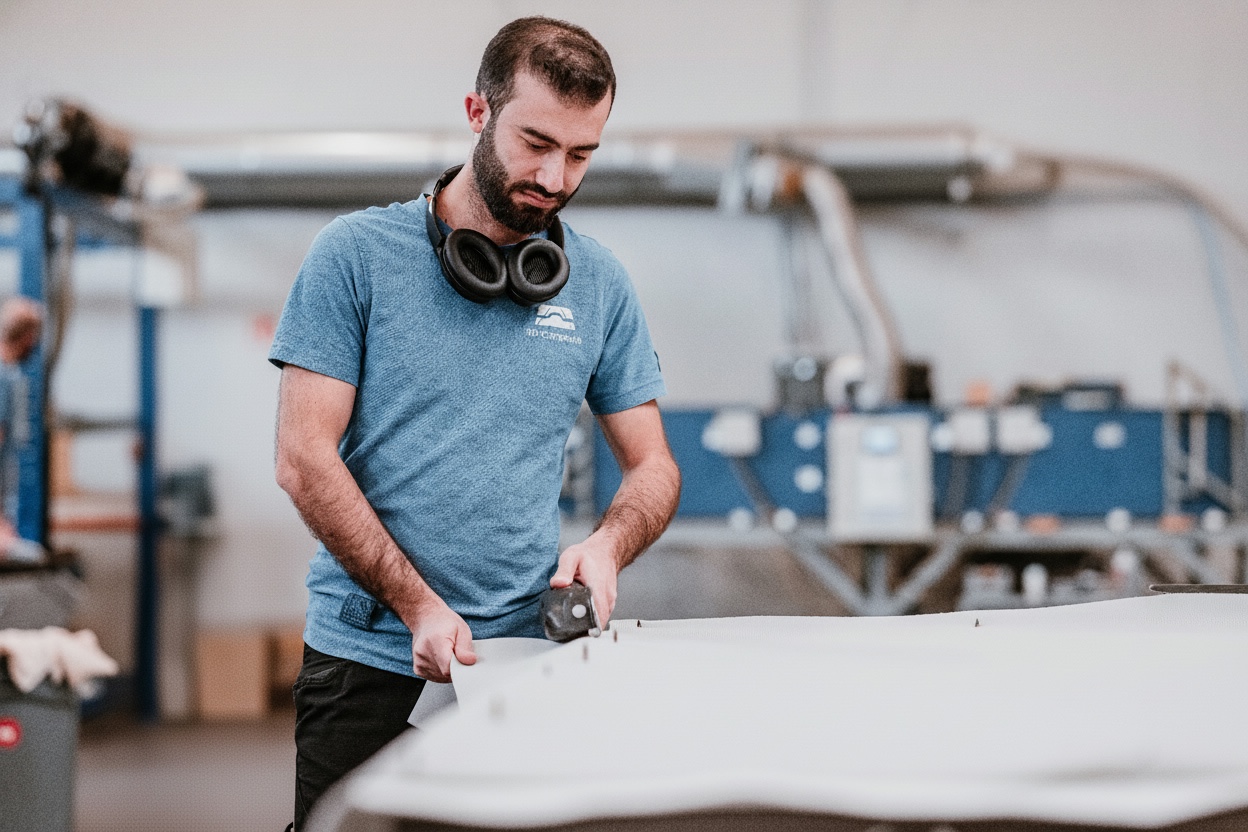
Compared to ABS thermoforming, thermoforming PES nonwoven fabric offers clear advantages. The components become more stable and lighter at the same time. Surfaces feel more luxurious and are better suited for interior use. In addition, the carrier layer, adhesive layer and fabric covering can be formed and bonded in a single step, saving additional work steps. The nonwoven fabric naturally dampens sound and vibrations, thereby improving the acoustic properties of the vehicle. The result is a durable and functional component with a high degree of design freedom.
Here you will find typical areas of application for our thermoformed components. The examples show the applications in which our materials fully demonstrate their special properties. Depending on the desired requirements, we select the appropriate raw material and the optimal manufacturing process in order to achieve the best technical and economic solution for each component.
Weight plays a crucial role in caravans and motorhomes. That is why the cladding on A and B pillars, roof undersides and other interior parts is usually relatively thin. We generally manufacture such moulded parts using our composite materials in a thermoforming process. With low weight due to low material thickness, they remain permanently flexible and impact-resistant.
The rear wall panelling of a box van is relatively large in terms of surface area and must be very stable. By selecting the right carrier materials and synthetic resins, we can also produce a thin, lightweight but very robust moulded part using the thermoforming process.
The interior of agricultural machinery is usually very complex in design, which is why it is assembled from a wide variety of smaller trim elements. Here too, the thermoforming process is used for many, though not all, components.
Acoustic panels noticeably improve room acoustics by absorbing sound and reducing disruptive reflections. At the same time, they enable attractive shapes and surfaces, allowing functional acoustic solutions to be harmoniously integrated into the design concept of living spaces, offices or vehicle interiors.
It never ceases to fascinate us! Whether plastic fibres, high-quality wool felt, hemp fabric or a sisal mat – as soon as the material enters one of our presses, it is transformed, taking on a third dimension, sharp contours, soft curves and a completely new surface structure. The soft fabric becomes impact-resistant and robust, the inconspicuous textile is upgraded and becomes an indispensable part of a design. The variations of this transformation are endless: countless carrier materials, colours and shapes result in ever new products! There are (almost) no limits to your ideas…
Let us discuss your project – we will find the right solution.